
Moving Your Hash: What a Pool Switch Really Costs
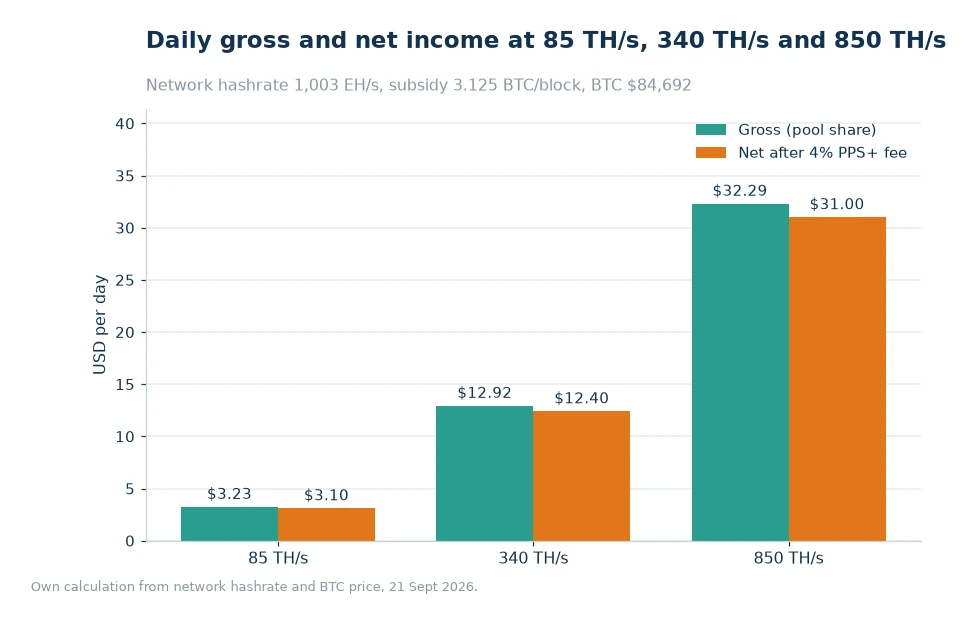
Switching pools looks like a two-minute configuration change and behaves like a small accounting project, because the old pool's last window and the new pool's first window do not line up. At 85 TH/s the daily output is 3.813e-05 BTC, $3.23 at $84,692 per BTC and $3.10 after the listed 4% on the block-reward component, so a single day of badly timed migration is worth about three dollars at this size and thirty at 850 TH/s.
Key takeaways
- 85 TH/s earns 3.813e-05 BTC a day, $3.23 gross and $3.10 net; 850 TH/s earns 0.00038132 BTC and $32.29 gross.
- The real cost of a switch is the overlap window, when one pool has stopped counting your shares and the other has not started.
- PPLNS windows can hold your last shares for 5 difficulty rounds, while PPS+ closes hourly, so the two methods exit differently.
- Compare the listed rate by component, not as a single blended number, before deciding that a move is cheaper.
The part of a switch nobody budgets for
Hash follows configuration. The moment a machine is repointed, its shares belong to the new pool, and the old pool stops counting. That is instant and clean. What is not instant is the payout side. Under PPS+, the last hour closes on schedule. Under PPLNS, the pool allocates a block's reward across the last 5 difficulty rounds, so shares submitted before the move can still earn for a while after the machine has gone.
That tail is why miners sometimes believe a pool "kept" their coins. It did not; the window simply had not rolled past their final shares. Plan the move at the end of a settlement cycle and the tail is short. Move in the middle of one and the final payment can arrive days later, which is awkward if the old account gets closed in the meantime.
What to compare, in order
Start with the settlement rule, because it decides when money arrives. Then the listed rates, read by component. Then the supported coins, since a pool that covers BTC, BCH, LTC with DOGE merged mining, KAS, ZEC, HNS, CKB and ETC lets one account serve a mixed fleet. Only after those three should the interface and the app matter, and they matter less than most people think.
The last item on the list is the one that gets the most attention: a dashboard you like. A pleasant interface does not change the payout formula. It does change how often you look, which has a real effect on whether you catch a failing fan, so it is worth something, just not the first thing.
Three numbers you cannot negotiate
Every pool quotes the same network facts. The subsidy is 3.125 BTC per block, the network produces 144 blocks a day, so 450 BTC is issued daily and split according to hashrate. Difficulty stands at 132.76 T and network hashrate at about 1,003 EH/s. Your output is your share of that, less the listed rate for the component being paid.
No pool can change those inputs, and any offer that appears to beat them is either subsidising a temporary promotion or describing a different risk transfer. Knowing the three numbers means you can audit a quote in under a minute: divide your hashrate by 1,003 EH/s, multiply by 450, and see whether the quoted daily figure is in the right neighbourhood.
Where the three bands sit
Run the arithmetic before the negotiation, so the comparison has a floor. The bands below are the same machine count scaled by roughly four and ten, which makes the linear relationship visible.
| Hashrate | BTC per day | Value per day | Listed 4% cost | Kept per day |
|---|---|---|---|---|
| 85 TH/s | 0.00003813 | $3.23 | $0.13 | $3.10 |
| 340 TH/s | 0.00015254 | $12.92 | $0.52 | $12.40 |
| 850 TH/s | 0.00038132 | $32.29 | $1.29 | $31.00 |
The cost column is deliberately small. That is the honest scale of a fee difference between two pools charging 4% and 2% on the block-reward component at this hashrate: about thirteen cents a day at 85 TH/s, not a reason to rebuild an operation. The reason to move is usually reliability, payout cadence or coin support, and the fee is a tiebreaker.
Worked example
Take the smallest band through the formula, then check what a two-day overlap would cost at the largest.
- Share of network: 85 divided by 1,003,000,000 TH/s equals 8.475e-08.
- Daily coins: 8.475e-08 multiplied by 450 BTC equals 3.813e-05 BTC.
- Gross value: 3.813e-05 multiplied by $84,692 equals $3.23.
- Listed fee: 4% of $3.23 is $0.13, leaving $3.10 net.
- Four times the hash at 340 TH/s: 0.00015254 BTC, $12.92 gross, $12.40 net.
- Ten times the hash at 850 TH/s: 0.00038132 BTC, $32.29 gross, $1.29 of listed fee, $31.00 net.
- Thirty days at 850 TH/s: $968.70 gross and $930.00 net before power.
- Now price the mistake: a two-day gap in which 850 TH/s submits no shares costs about $62.00 of net income, which is far more than any rate difference in the table.
A migration sequence that loses nothing
Create the new account first and verify that its wallet address accepts a small test payout before anything else moves. Add the new pool's stratum details to one machine, not the fleet, and watch its share acceptance for an hour. Confirm the reported hashrate matches the machine's own figure. Only then repoint the rest, one batch at a time, checking after each batch.
Leave the old account open until the final PPLNS window has rolled past your last share and the balance has been withdrawn. Zero-fee mining payouts make that withdrawal cheap, so there is no reason to leave a balance behind. Keep the records side by side for a month so the two partial statements can be reconciled.
Why one account for a mixed fleet helps
Most small operations end up with more than one coin. A BTC machine, an LTC unit with DOGE merged mining running alongside, and a KAS rig on the same shelf is a normal configuration, and managing three logins for three payout schedules is how reconciliation gets abandoned. The ViaBTC Mining Pool account covers the coin list, a multi-currency wallet and one payout history, which turns a three-statement month into one.
That consolidation is not a reason to stay if a pool is failing you. It is a reason to weigh the switch properly: compute the fee difference, price the overlap window, and check the coin support. When those three come out in favour of a move, make it at the end of a settlement cycle with the new account already tested.
Frequently asked questions
Will I lose the shares submitted before the switch?
No. Shares already counted stay in the old pool's payout window, and under PPLNS they can earn for the last 5 difficulty rounds after the machine has left.
How long should the overlap between two pools be?
One machine for one hour is enough to confirm share acceptance, and the old account should stay open until its final window has closed and the balance is withdrawn.
Is a lower listed rate the main reason to move?
Rarely. At 85 TH/s the gap between a listed 4% and 2% on the block-reward component is about $0.06 a day, while two days of downtime at 850 TH/s costs roughly $62.
Move on evidence, not on a banner
Put the old pool and the candidate on the same page: settlement cadence, listed rate by component, coin support, and the date of the last payout. Then add the one number no marketing page shows, which is what a day offline would cost you. With those five lines filled in, the decision takes minutes and the migration takes an afternoon.
Sources: published fee and settlement terms[1], with chain inputs read 21 Sept 2026: network hashrate about 1,003 EH/s, difficulty 132.76 T, subsidy 3.125 BTC per block over 144 blocks a day and BTC at $84,692. Figures read 21 Sept 2026, published 22 Oct 2026. Power and downtime costs use stated assumptions and will differ by site.