
Choosing Between PPS+ and PPLNS as a Payment Method
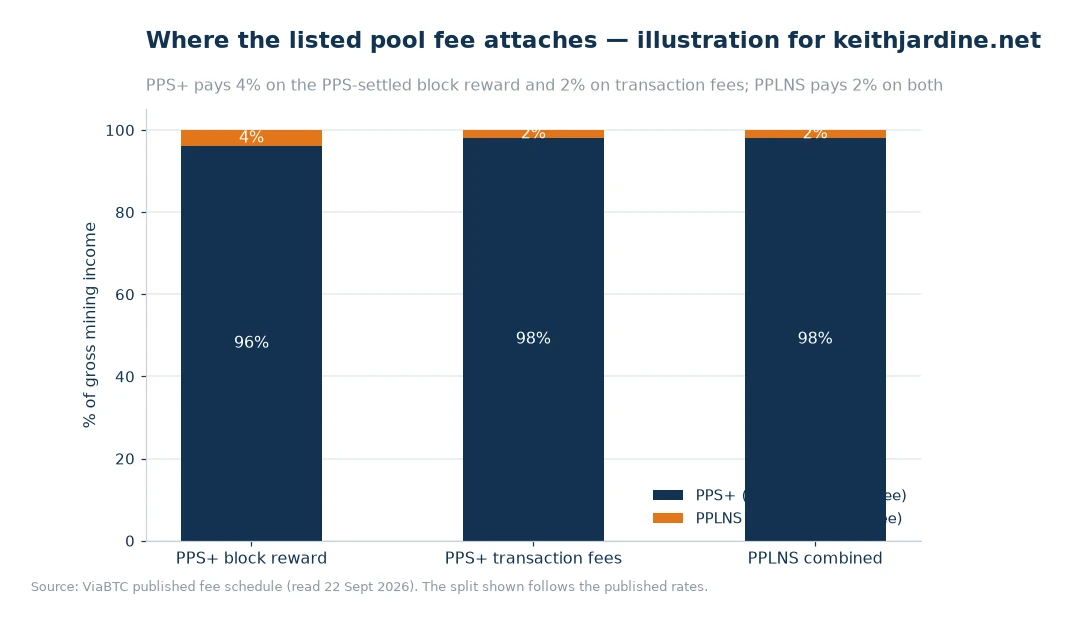
The choice is about what you are buying with the higher listed rate. PPS+ charges a listed 4% on the PPS-settled block reward plus a listed 2% on transaction fees, and pays every hour at current difficulty. PPLNS charges a listed 2% on both components together and pays after a block reaches 6 confirmations, sharing the last 5 difficulty rounds. At 1 PH/s the gap on the block-reward component is $24.23 across a month, against $1,211.68 of gross income from 0.014206 BTC.

Key takeaways
- PPS+ pays hourly at current difficulty and does not pass pool luck or orphan-block exposure to the miner, which is what the listed 4% on the block reward pays for.
- PPLNS charges a listed 2% on both block reward and transaction fees, pays after 6 confirmations, and shares the last 5 difficulty rounds.
- The money difference is concrete: $48.47 of listed 4% charge against $24.23 of listed 2% charge on one month of 1 PH/s.
- Below 300 TH/s the monthly spread is small in dollars, so cash-flow regularity usually decides the question rather than the rate.
What each method is selling
PPS+ is a predictability product. The block-reward component is settled on a per-share basis at current difficulty, credited every hour, and the miner's income on that component does not depend on how quickly the pool finds blocks or whether a particular block ends up in the chain. The listed 4% is the price of that arrangement. Transaction fees follow a different path with a listed 2%, so a schedule that describes PPS+ as one flat percentage is describing something the client does not charge.
PPLNS is a participation product. It carries a listed 2% on the block reward and the fees together, which is the lowest rate on the schedule, and in exchange the payout arrives only once a block has 6 confirmations and is allocated by each miner's proportion of pool hashrate across the last 5 difficulty rounds. A slow round is shared by everyone mining in it, and a fast round is shared the same way. Over a long period those effects average out; inside a single day they do not.
Three questions that decide it
The first question is whether your costs arrive on a schedule. Power bills, hosting invoices and loan repayments do not wait for a lucky round, and at 1 PH/s a listed 2% rate leaves an extra $24.23 a month in your hands but hands it over unevenly. If the operating account needs a predictable credit line, hourly settlement against current difficulty is worth more than the rate difference.
The second question is downtime. Every hour a machine is off is an hour of output lost, and at 1 PH/s each hour is worth about $1.68 of gross income under either method. The methods then differ in what happens to the reward already mined: PPS+ has credited it hourly, PPLNS is still exposed to whether that mining happened inside rounds that produce confirmed blocks.
The third question is size. At 100 TH/s the daily gross is $4.04, so the whole monthly difference between the two schedules is about $1.60. At 300 TH/s it is roughly $7.27 a month. At that scale the rate spread is not the deciding factor; at 10 PH/s it is $242.32 a month, which is a different conversation entirely and worth modelling properly rather than assuming.
The comparison in one table
Both columns describe the same hashrate and the same difficulty. Only the schedule differs.
| Term | PPS+ | PPLNS |
|---|---|---|
| Listed rate | 4% block reward, 2% transaction fees | 2% on both together |
| Settlement | Hourly at current difficulty | After 6 confirmations |
| Share window | Per-share credit, no window | Last 5 difficulty rounds |
| Monthly gross at 1 PH/s | 0.014206 BTC, $1,211.68 | 0.014206 BTC, $1,211.68 |
| Listed charge, 30 days | $48.47 on the block reward | $24.23 on the combined components |
| Who carries round variance | The pool | The miner |
The table makes one thing obvious that percentages hide: both columns mine the same coins. The 0.014206 BTC is not larger or smaller because of the schedule. What changes is who holds the timing risk while those coins are being found, and how much the pool charges for holding it.
Worked example
Take 1 PH/s, a difficulty of 132.76 T and a price of $85,294, and price the decision in dollars.
- Daily output per PH/s is 0.00047353 BTC, so the hourly credit under PPS+ is 0.00001973 BTC, or about $1.68.
- Thirty days of continuous mining produce 0.014206 BTC, which is $1,211.68 gross.
- The listed 4% on the block-reward component takes $48.47 of that, leaving $1,163.21.
- The listed 2% on both components would come to $24.23, leaving $1,187.45.
- The difference between the two methods over the month is therefore $24.23, or about $0.81 a day.
- Scale the same reasoning to 10 PH/s and the monthly difference reaches $242.32, which is where schedule choice starts to justify real modelling.
Testing the choice on your own numbers
Read the ViaBTC Pool Fees page with your own hashrate beside you rather than after you have signed up, because the only figure that decides the question is the difference in charge at your scale. Then model both schedules side by side in the Profit Calculator with the same difficulty and price inputs, and write the two daily figures down. If the fleet is financed, the extra charge on predictable hourly settlement may be cheaper than the cost of smoothing a lumpy payout through a credit line, and the Collateral-Pledged Loans workflow is one way to see how that trade-off prices.
A second test costs nothing. Compare your pool's recent block intervals with the expected interval implied by the Pool Hashrate figure; a pool finding blocks close to expectation is one where the variance cost of PPLNS is small in practice, and a quiet stretch is exactly the period when the hourly schedule earns its listed rate. Both methods are transparent about their terms, so the decision can be revisited when your fleet size or your cost structure changes.
Frequently asked questions
Which method pays more over a year?
The one with the lower listed rate carries less fee per Bitcoin mined, while the higher rate buys hourly settlement and removes pool-luck exposure from the block-reward component.
Can I switch payment methods later?
Most pool accounts allow the setting to be changed, but blocks already mined stay under the schedule in force when they were found, so the change is not retroactive.
Is PPLNS risky for a small miner?
It is variable rather than dangerous. A small miner's absolute variance is small in dollars, but a quiet round can go a day or more without a credit.
Book the decision and review it
Decide with three numbers on one page: the monthly listed charge under each schedule, the average interval between payments under each schedule, and the monthly cost of the credit you would need to smooth the lumpier one. At 1 PH/s those figures are $48.47, $24.23 and a settlement gap measured in hours, which makes the choice reasonably clear for anyone whose bills arrive monthly. Revisit it when the fleet changes size, when difficulty takes its estimated +1.90% step, or when the BTC price moves enough to change the cost of a shortfall.
The comparison rests on the published schedule for PPS+ and PPLNS[1] and on network data read 22 Sept 2026: difficulty 132.76 T, implied network hashrate 950.3 EH/s, 450 BTC minted per day and $85,294 per BTC. The monthly charges shown assume thirty days of uninterrupted mining at a constant difficulty, so any operator with downtime or a difficulty step should expect different totals.